Anonymous authors. Paper under double-blind review at ICLR 2027.

SRTDrive Safety-Aware Trajectory Refinement via Reference-Relative Supervision

A frozen end-to-end planner can output a plan that collides when a small adjustment would not. SRTDrive keeps that plan as a reference, generates alternatives as deformations of it, and learns when to keep it and when to replace it.

Code will be released on this page.

Schematic bird's-eye view of how SRTDrive selects a trajectory The frozen planner's reference trajectory is drawn in orange, generated alternatives in light blue, and the selected output in dark blue. In the replace case the reference clips a parked vehicle and an alternative that clears it is selected. In the keep case the reference ranks first and is output unchanged.
  • Reference
  • Alternatives
  • Selected output

The reference clips a parked vehicle. An alternative that clears it ranks first and becomes the output. The reference ranks first, so the planner's plan is output unchanged. Schematic, not data.

  • 43.07to47.77

    Driving Score

    Bench2Drive, VAD-Base

  • 95to86

    Routes with a collision, of 220

    Bench2Drive, VAD-Base

  • 88.76to90.78

    Driving Score

    Bench2Drive, BevAD-M

  • 0.165to0.125

    Collision rate, %

    nuScenes, VAD

Frozen planner aloneSame planner with SRTDrive

Abstract

End-to-end planners output a single final plan that can still collide with surrounding agents, even when a small adjustment could avoid the collision. Retraining the planner changes its weights and acquired behavior, and learned candidate scorers are not trained to judge a replacement relative to the original plan.

We propose SRTDrive, a post-hoc refinement framework that leaves the planner frozen, keeps its output unchanged as a reference trajectory, and learns whether to retain or replace it. A generator produces alternatives as deformations of the reference along and across its path, so that every alternative is directly comparable to the original plan. A selector then scores each candidate relative to the reference and is trained so that a replacement that increases collision at any horizon is never the target, however close it is to the logged trajectory; trajectory error only ranks equally safe candidates. At inference, the top-ranked candidate, possibly the reference itself, is output without a collision threshold.

On Bench2Drive, SRTDrive raises the Driving Score of VAD-Base from 43.07 to 47.77 and reduces the routes with collisions from 95 to 86, whereas the same candidates selected by a TTC rule do not yield these gains. On nuScenes, applied to seven frozen planners with one module trained per planner, it lowers L2 error on five and the collision rate on three, with the largest gains on VAD.

How it works

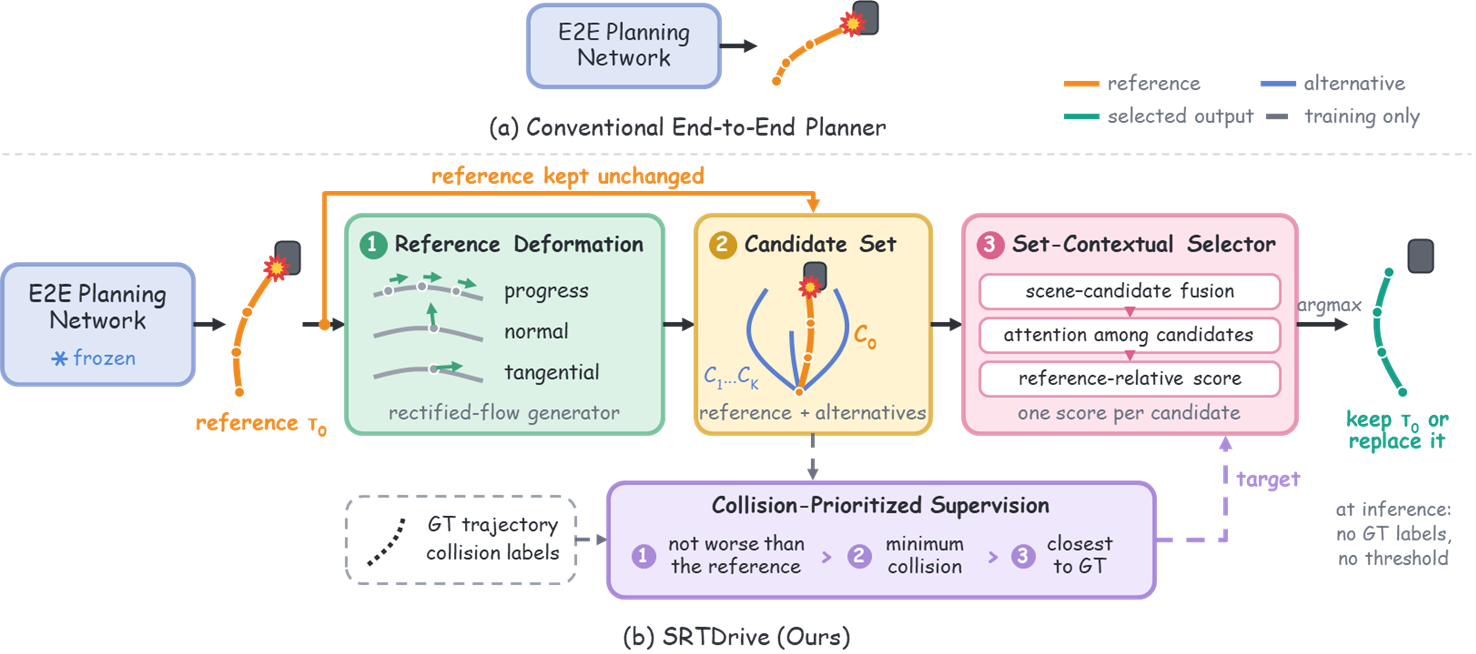
The planner is never retrained. Its output serves twice: as the anchor that alternatives are generated around, and as the baseline every candidate is scored against.

Diagram. Top: a conventional end-to-end planner outputs one plan that collides. Bottom: SRTDrive keeps the frozen planner's output as the reference, deforms it into alternatives, puts the reference and alternatives in one candidate set, and a set-contextual selector outputs the top-ranked candidate. Collision-prioritized supervision builds the training target.
Overview. A conventional planner outputs one final plan that may still collide (a). SRTDrive keeps the planner frozen, takes its output as the reference, and keeps or replaces it (b).
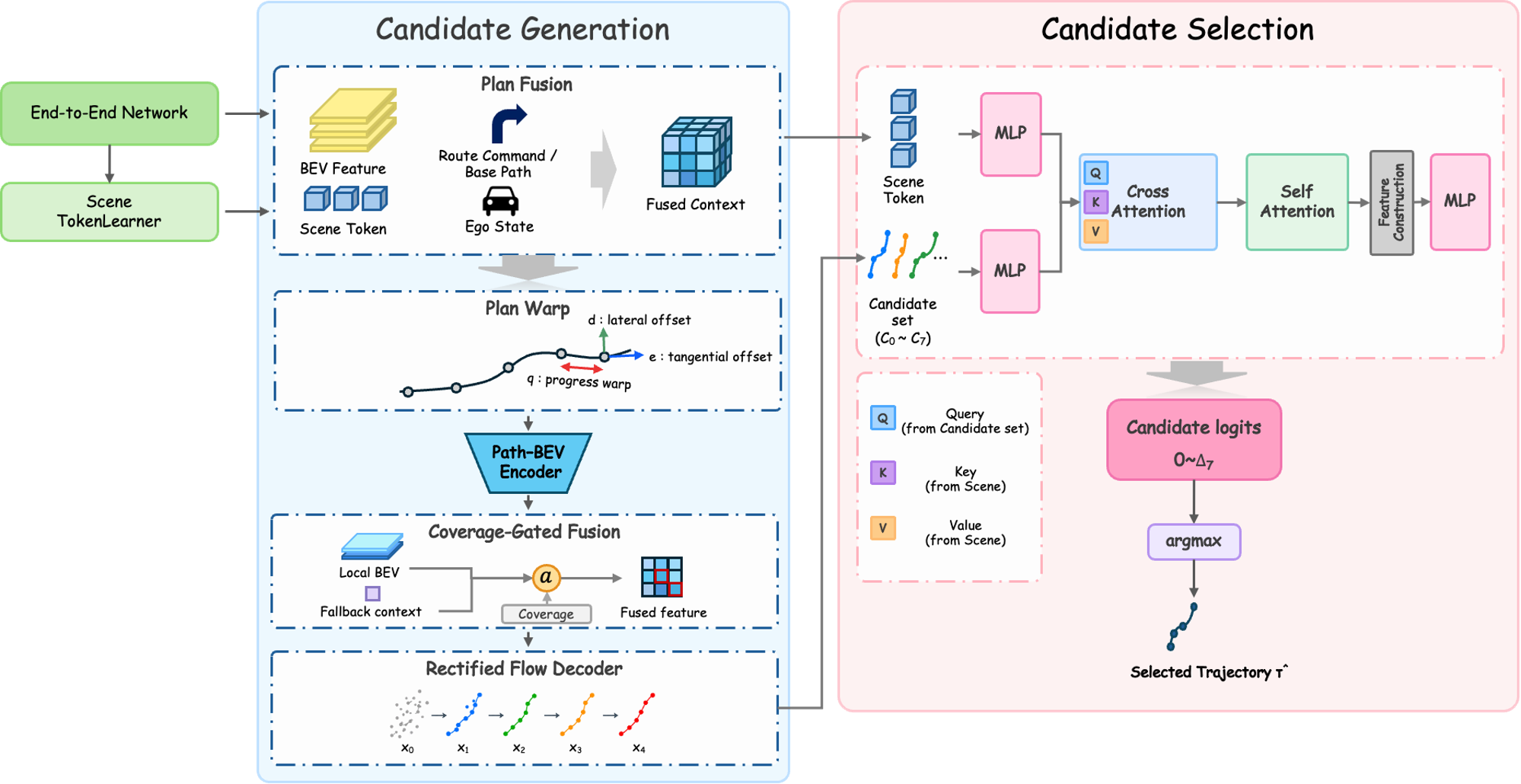
Architecture diagram. Candidate generation: plan fusion of BEV features, scene tokens, route command and ego state; plan warp with progress, lateral and tangential offsets; a path-BEV encoder; coverage-gated fusion; and a rectified-flow decoder. Candidate selection: scene tokens and the candidate set pass through cross-attention and self-attention to produce candidate logits, and the argmax is the selected trajectory.
Architecture. The generator conditions on the reference, path-local BEV features, scene tokens, driving command and ego state. The selector contextualizes all candidates, including the reference, and outputs the top-ranked one as is.
  1. Deform the reference

    A rectified-flow generator produces seven alternatives as deformations of the reference: progress along its path, plus normal and tangential offsets. Every alternative stays directly comparable to the original plan.

  2. Keep the reference in the set

    The planner's trajectory joins the candidates unchanged. It is scored as one candidate, not assumed to be safe.

  3. Score relative to the reference

    A set-contextual selector attends across candidates and computes every logit from a candidate–reference pair. The top-ranked candidate is output as is.

Collision comes first

The selector learns a strict order: a later criterion only breaks ties left by the one before it.

  1. No worse than the referenceCollision does not increase at any of the 1, 2 and 3 s horizons.
  2. Minimum collisionAmong those, the lowest average collision.
  3. Closest to the logged trajectoryDisplacement error only ranks equally safe candidates.

Results

Frozen planner aloneSame planner with SRTDrive

In closed loop, the Driving Score rises and fewer routes contain a collision

On the 220 official Bench2Drive routes, VAD-Base with SRTDrive completes more of each route, succeeds on five more, and collides on fewer. The much stronger BevAD-M moves the same way.

VAD-Base

Driving Score

Planner alone 43.07 With SRTDrive 47.77

+4.70

Success Rate %

Planner alone 16.82 With SRTDrive 19.09

+2.27

Route Completion %

Planner alone 63.64 With SRTDrive 70.04

+6.40

Routes with a collision of 220, fewer is better

Planner alone 95 With SRTDrive 86

−9

BevAD-M

Driving Score

Planner alone 88.76 With SRTDrive 90.78

+2.02

Success Rate %

Planner alone 72.73 With SRTDrive 75.00

+2.27

Route Completion %

Planner alone 96.47 With SRTDrive 97.72

+1.25

Routes with a collision of 220, fewer is better

Planner alone 42 With SRTDrive 35

−7

Bars start at zero and span each metric's full range: 0 to 100, or 0 to 220 routes. The collision-route count is an auxiliary measure, not an official Bench2Drive metric, and is not normalized by distance driven. SRTDrive adds 98 ms per planning step, about 11% of VAD-Base's own 876 ms.

All Bench2Drive metrics, with Efficiency, Comfort and the ability breakdown
Closed-loop metrics on the 220 official routes. Bold is the best value within each planner block.
MethodDriving ScoreSuccess Rate, %EfficiencyComfort, %Route Completion, %Routes with a collision
VAD-Base43.0716.82163.8450.8063.6495
VAD-Base, same candidates with a TTC rule39.5612.27165.6733.7379.69172
VAD-Base with SRTDrive47.7719.09168.6040.2670.0486
BevAD-M88.7672.73239.1710.9096.4742
BevAD-M with SRTDrive90.7875.00239.7811.2397.7235
Multi-ability success rate, %. Each ability is scored on a subset of the routes, so a difference can correspond to only a few routes.
MethodMergingOvertakingEmergency brakeGive wayTraffic signMean
VAD-Base11.2520.0020.0030.0023.6820.99
VAD-Base, same candidates with a TTC rule10.0013.338.3340.0026.3219.60
VAD-Base with SRTDrive12.5011.1133.3320.0030.0021.39
BevAD-M72.5071.1173.3370.0083.1674.02
BevAD-M with SRTDrive71.2566.6786.6770.0082.6375.44

Same candidates, different selector

Keep the generator and swap only the selection step. A time-to-collision rule and a learned pointwise scorer both do worse than the base planner alone. The reference-relative selector is the only one that improves on it, on both measures.

Driving Score higher is better

TTC rule39.56
Pointwise scorer40.14
SRTDrive selector47.77

VAD-Base without refinement, 43.07

Routes with a collision of 220, fewer is better

TTC rule172
Pointwise scorer108
SRTDrive selector86

VAD-Base without refinement, 95

Bench2Drive, VAD-Base, 220 routes, one run per configuration. All three use the same frozen generator with seven alternatives per step; only the selection step differs.

Open-loop ablations, and a comparison with ResWorld FGTR
Swap the selector nuScenes, VAD, same candidates
SelectorL2, mCollision, %
None, VAD reference0.7230.165
Learned pointwise scorer0.7220.143
Without reference-relative features0.7220.131
Conventional collision-aware ranking0.7030.151
Full selector0.6770.125
Swap the generator nuScenes, VAD, after selection
Candidates fromL2, mCollision, %
None, VAD reference0.7230.165
Lateral offset0.7520.148
Speed adjustment0.7800.156
Constrained perturbation0.7220.153
Deformation flow0.6770.125
Refine the same ResWorld plans nuScenes
MethodL2, mCollision, %
Initial trajectory0.3170.036
ResWorld FGTR0.3020.118
SRTDrive0.3190.036

On ResWorld plans the two schemes trade off differently: FGTR lowers L2 and raises the collision rate, while SRTDrive keeps the initial collision rate at a slightly higher L2. In a separate matched comparison, collision-prioritized supervision cuts collision-introducing replacements from 6 to 2 against L2-only supervision, with L2 rising from 0.698 to 0.708 m.

Open loop on seven frozen planners

SRTDrive attaches to seven planners of different designs without retraining any of them. L2 falls on five and the collision rate on three, with the clearest gain on VAD. On SparseDrive and DiffusionDrive both metrics move slightly the wrong way.

Frozen planner L2, m lower is better Change Collision rate, % lower is better Change
VAD 0.7230.677 −0.046 0.1650.125 −0.040
UniAD 1.0861.079 −0.007 0.2820.277 −0.005
GenAD 0.5420.541 −0.001 0.1830.167 −0.016
DMAD 0.6190.614 −0.005 0.1470.161 +0.014
IR-WM 0.9010.888 −0.013 0.6440.644 0.000
SparseDrive 0.6080.613 +0.005 0.1030.109 +0.006
DiffusionDrive 0.5670.573 +0.006 0.0790.084 +0.005

nuScenes validation, averaged over the 1, 2 and 3 s horizons. Each planner is evaluated with its own released protocol, so values compare within a row, not across rows. Change bars share one scale; a bar to the left is a decrease.

What replacement does to collisions

Inside the decisions of the VAD-based model on nuScenes validation: how often a colliding plan is repaired, and how often replacing a plan changes its collision metric at all.

25 of 63 colliding references are improved

  • 20Collision removed at every timestep
  • 5Collision reduced
  • 15Improving alternative generated, not selected
  • 23No improving alternative generated

3,987 replacements, almost none change collision

77.9%
of 5,119 valid samples are replaced; the reference is kept in the other 22.1%.
> 99.3%
of replacements leave the collision metric unchanged, at every horizon.
25 vs 2
replacements lower the 3 s collision metric versus raise it.

Small adjustments, not a new route

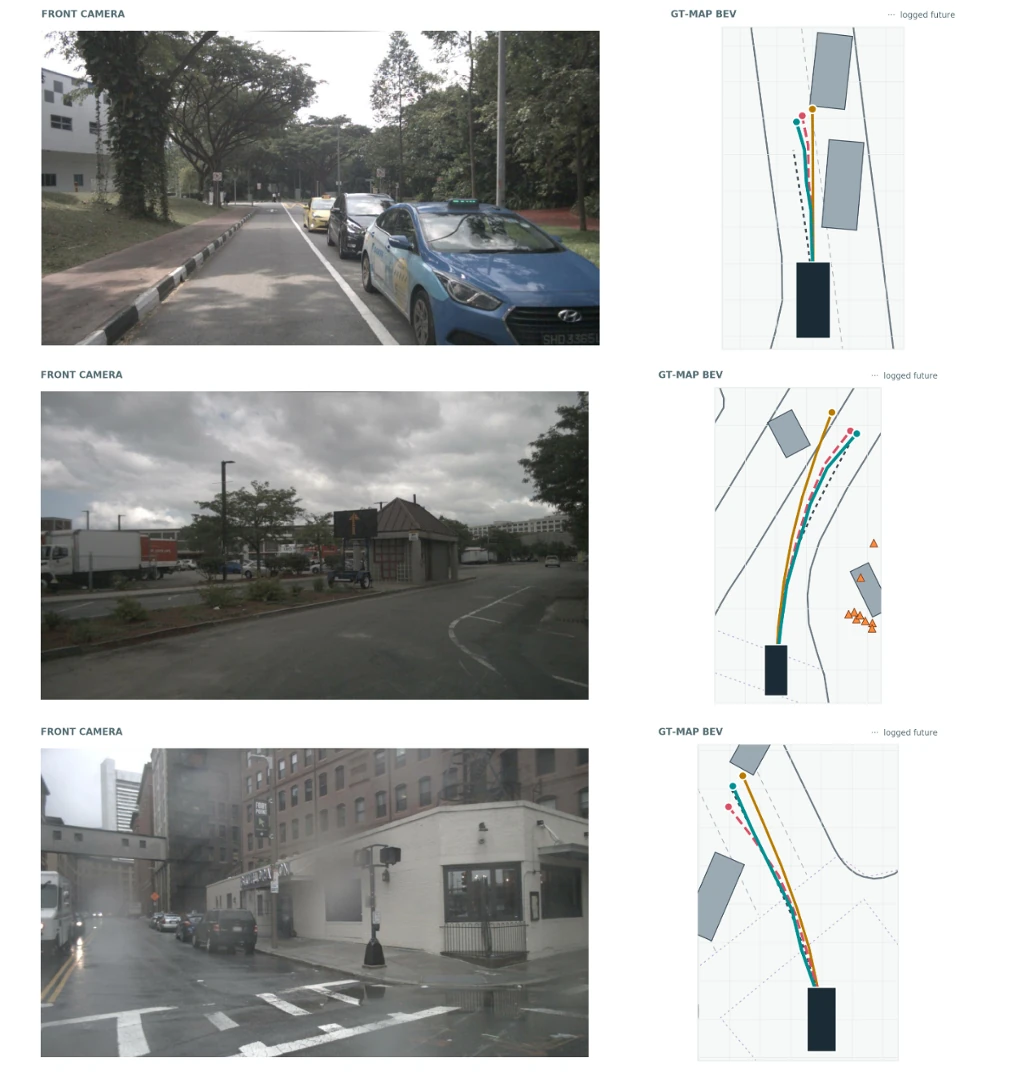
On nuScenes validation with VAD as the base planner, the SRTDrive output stays close to the logged trajectory while the reference drifts from it. The corrections are small lateral and progress adjustments of the reference.

  • Logged future
  • VAD reference
  • TTC rule on the same candidates
  • SRTDrive output
Front camera: a narrow road with cars parked along the right side. Bird's-eye view: the reference runs straight toward two parked vehicles, while the SRTDrive output bends left along the logged future.
The reference drifts toward the parked vehicles.
Front camera: a wide curve to the right under an overcast sky. Bird's-eye view: the reference cuts across the lane toward a vehicle, while the SRTDrive output follows the curve of the logged future.
The reference drifts across the lane toward a vehicle.
Front camera: a wet city intersection with a crosswalk. Bird's-eye view: the SRTDrive output stays on the logged future through a left turn, while the reference runs wide of it.
The reference runs wide of the logged future; the output stays on it.

Bird's-eye views show ground-truth map elements and agents: gray boxes are vehicles, triangles are pedestrians. Select a scene to open the full figure.

Limits

What the evidence does not show.

  • The priority is learned, not enforced

    The collision-first order is a learned preference with no threshold behind it at inference. At 3 s, 2 of 3,987 replacements on nuScenes raise the collision metric.

  • Selection is independent at each step

    With VAD-Base, consecutive plans vary more and closed-loop Comfort falls from 50.80% to 40.26%. The analysis does not establish that one causes the other.

  • Alternatives stay near the reference

    Deformations cannot express a different route. Overtaking success drops on both planners: 20.00% to 11.11% on VAD-Base and 71.11% to 66.67% on BevAD-M.

  • Gains are not uniform

    Open-loop nuScenes results are mixed across planners, and NAVSIM v2 with VADv2 shows no aggregate gain (82.167 to 82.166, non-reactive). Planners with unfavorable open-loop changes were not evaluated in closed loop.

BibTeX

Author names are withheld during double-blind review.

@misc{anonymous2027srtdrive,
  title  = {SRTDrive: Safety-Aware Trajectory Refinement via Reference-Relative Supervision},
  author = {Anonymous},
  note   = {Under review as a conference paper at ICLR 2027}
}